How to Read Travel Guide Descriptions Without Mistaking Them for a Place
Travel guide descriptions can narrow a destination to a few landmarks. Learn to check their framing, compare local sources, and choose visits with context.
The most common mistake with a travel guide is treating its description as a portrait of the whole place. That shortcut can make a visit feel thin: you reach the famous overlook, recognize the image, and leave without knowing what the guide selected—or what it left unmentioned. Travel guide descriptions are useful starting points, not complete accounts.
A guide has limited space and a clear job: help a reader picture a destination and make practical decisions. Its focus may be a landmark, a route, or a particular kind of visitor. Reading that focus as a point of view, rather than a verdict on what matters, helps you decide which details deserve your time.
A travel guide description selects details for a reason
A photograph of a skyline, a short caption about a market, or a recommended walk makes an unfamiliar place easier to imagine. The selection is useful, but it can also make one scene stand in for a district with many uses and rhythms.
Digital guides have their own cues: the first image, a prominent map pin, or a route leading straight to a landmark. These features help with orientation, but they do not explain how a site connects to the surrounding streets or what happens there outside the visitor’s view.
When a description catches your attention, identify its subject precisely. Is it inviting you to see a building, follow a path, buy something, or adopt a mood? That distinction lets you assess the recommendation on its actual merits instead of taking its language as a full account of the destination.
Repeated recommendations can obscure a destination’s other uses
Guidebooks, visitor maps, travel columns, and search results often make recognizable places easy to find. A landmark may therefore seem like the natural center of a destination, even when daily activity is spread across several neighborhoods or public spaces.
Ordinary places can provide different context: a bakery opening for the morning, a public library serving its neighborhood, or a transit stop connecting residential streets. They are not automatically more revealing than famous sites, but they can help you understand how a destination functions beyond its best-known image.
Separate recognition from interest. A celebrated building may be worth seeing, but its prominence alone cannot tell you whether you want to visit, what access details matter, or how it fits your plans. Treat a recommendation as a lead you can accept, adapt, or set aside.
Words like “hidden” and “authentic” need context
Labels such as “hidden,” “untouched,” and “authentic” can frame a neighborhood as a discovery made for visitors. They may overlook the people who live and work there, or suggest that a place is more genuine when it appears unchanged.
Look for descriptions that explain a site’s use as well as its appearance. A market’s hours, a park’s role in public life, or the kinds of shops serving nearby residents can provide context that an atmospheric adjective does not. If a guide offers only mood, check a municipal neighborhood page, a local cultural organization, or another source with relevant information.
Say you read that a lane is “a secret corner of the old quarter.” You check the municipality’s neighborhood page and a local cultural organization’s site; both describe it as a route between a school, a clinic, and a public square. You decide to walk through without stopping in doorways or treating residents as part of the scenery. The result is a visit shaped by the lane’s stated everyday uses, rather than by the guide’s promise of secrecy.
Compare sources before deciding what a description means
A guide’s practical details may be more useful than its strongest adjective. Check access information against an official site where appropriate, use a transit map to understand connections, and consult a public institution or community organization when you need local context.
Use these checks to decide what to do next:
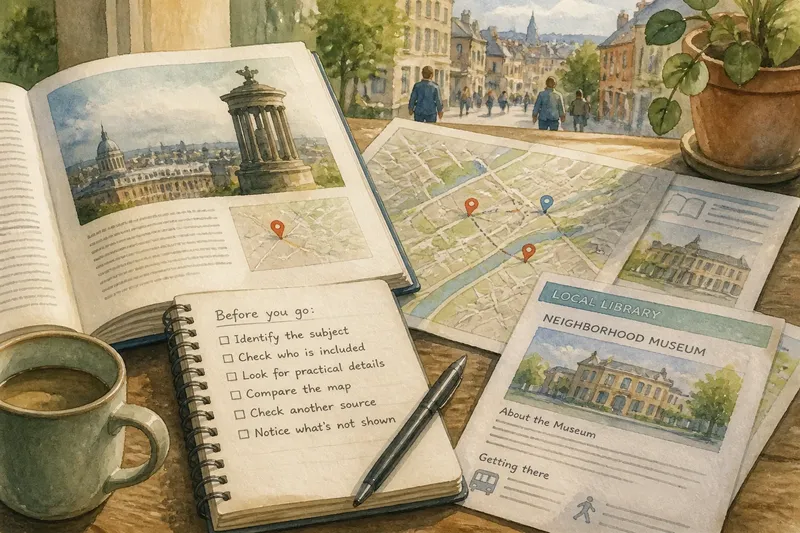
- Identify the recommendation’s subject. If it points to a specific building, view, business, or route, decide whether that feature interests you; if it offers only a broad mood, look for a source with concrete details.
- Check who appears in the description. If residents and workers are described only as scenery, seek a source that explains local use; if the guide gives that context, use it to shape a considerate visit.
- Look for missing practical details. If access, hours, or route information is absent, check an official or local source before setting out; if those details are clear, decide whether the timing and route fit your plans.
- Compare the map with the written account. If the map shows nearby public spaces or institutions the guide omits, decide whether to include one; if the map adds no useful context, keep the original route or choose another source.
- Check whether another source gives a different account. If a museum, library, or community organization describes another use or meaning, read that context before visiting; if accounts agree, treat the guide as one supported perspective, not the only one.
- Notice what the recommended photograph excludes. If the view hides a busy approach or working street, decide whether to adjust your route or expectations; if the setting is clearly represented, use the image as orientation rather than a promise about the whole place.
Imagine you are choosing between a celebrated viewpoint and a neighborhood museum mentioned on a local library page. The guide gives the viewpoint a striking photograph but says little about its surroundings; the library page explains what the museum covers and how it fits the district. You decide to visit the museum first, then walk toward the viewpoint if time and access allow. The tradeoff is clear: you may spend less time at the famous spot, but you arrive with more context for interpreting it.
Use map pins as locations, not explanations
A digital map can show where an attraction sits, but a prominent pin does not explain why the place matters or how it relates to nearby streets. Zoom out to see connections, check the route from your transit stop, and note public institutions that may offer their own account.
For a viewpoint, consider the approach as part of the visit. A route that passes working streets or public spaces can show how the landmark sits within its neighborhood. Keep access and local rules in mind, and avoid blocking entrances or interrupting everyday activity for a photograph.
What should you check before following a travel guide description?
How can you tell what a guide leaves out?
Compare the description with a local map, an official or public institution’s information, and the place’s stated everyday uses. If those sources add different details, treat the guide as one perspective and decide whether the added context changes your route or expectations.
Are travel guidebooks useful for understanding a place?
They can offer orientation, background, and practical information that helps you prepare. Read their recommendations as selected entry points, then consult another source when you need context the guide does not provide.
What should you do when a guide calls somewhere “authentic”?
Ask what the word refers to and whose point of view it represents. Look for specific information about local history, daily use, or public spaces, and base your plans on those details rather than the label alone.
How can you put a famous viewpoint in context?
Check the route, nearby public spaces, and any local sources that explain the surrounding district. If access and conditions suit your plans, visit the viewpoint with that context in mind; otherwise, choose another place to learn about the area.
Let a guide inform the visit without defining it
Travel guide descriptions work best as useful prompts: they can help you locate a place, understand a route, or decide what to investigate. Read their claims with attention to what is included, what practical details are missing, and whether another source offers relevant context.
Before leaving a site, make a note of one detail the guide described accurately and one question it did not answer. That gives you a specific starting point for a later check—perhaps a museum display, a local organization’s information, or an official map—and makes your next decision more informed.